K-12 Tutoring
Comprehensive AI tutoring support across all core subjects and grade levels, from kindergarten through 12th grade.
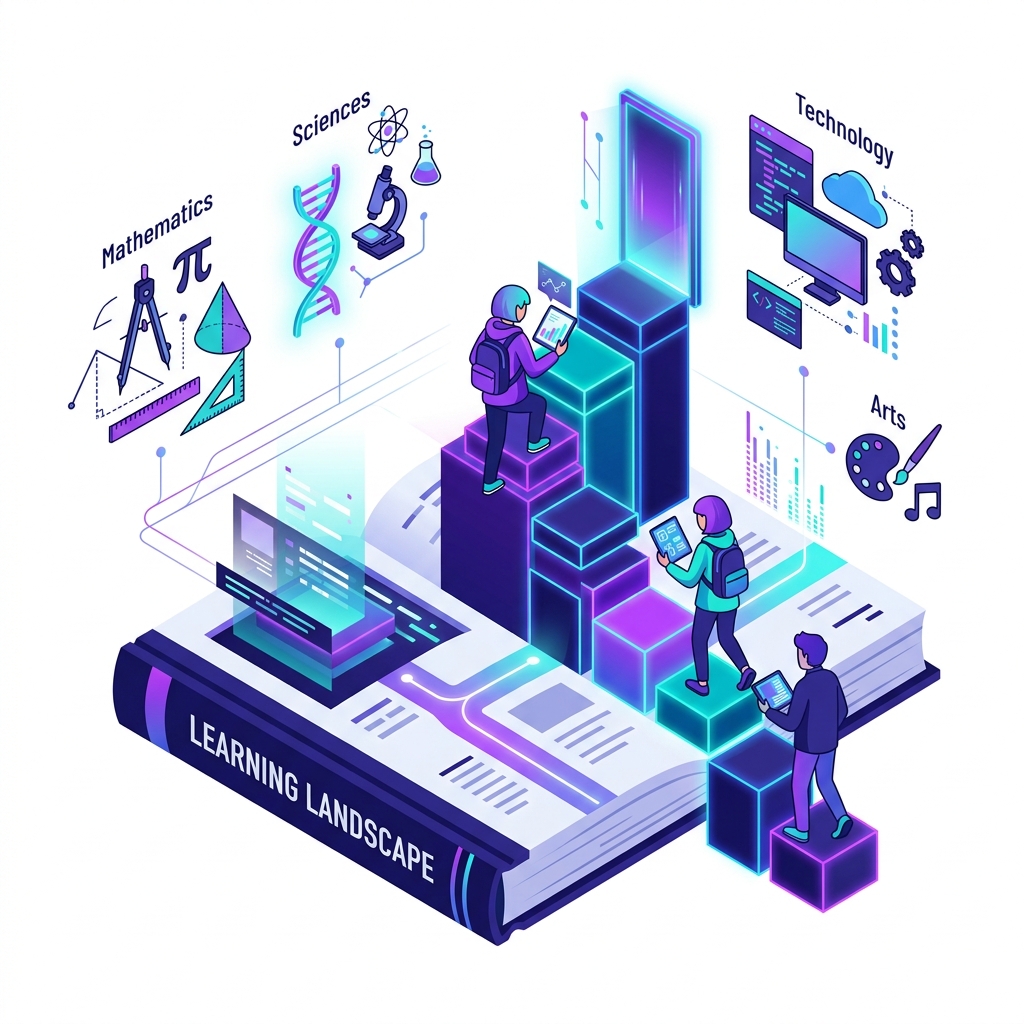
Available Subjects in K-12 Tutoring
Get personalized AI tutoring with CereBRO on any of the subjects below. Each subject adapts to you — the explanations, the examples, and the pace.
Art & Music Theory
Creative learning with AI — music theory, sight-reading, art history, visual art fundamentals, and more. CereBRO makes creative subjects accessible to every learner.
Computer Science & Coding
Learn to code with an AI tutor — Scratch, Python, JavaScript, web development, and AP Computer Science. CereBRO guides K-12 students through projects step by step.
English & Language Arts
Personalized English and Language Arts tutoring for K-12 — reading comprehension, essay writing, grammar, vocabulary, and literature analysis with AI guidance.
Foreign Languages
Conversational AI language tutoring for K-12 — Spanish, French, Mandarin, and more. Practice speaking, reading, writing, and grammar at your own pace.
History & Social Studies
AI tutoring for history and social studies — world history, US history, civics, geography, and AP courses. Engaging Socratic dialogue helps students connect events and ideas.
Mathematics (K-12)
AI-powered math tutoring for K-12 students — from counting and fractions through algebra, geometry, trigonometry, and pre-calculus. CereBRO adapts to your grade level.
Physical Education & Health
AI-assisted learning for PE and health classes — nutrition, body systems, fitness principles, health literacy, and wellness concepts for K-12 students.
Science (Biology, Chemistry, Physics)
Adaptive AI science tutoring covering biology, chemistry, and physics for K-12 students. Interactive concept explanations, lab prep, and exam practice.
Pick a Subject and Start Your First Free Lesson
Pick a subject below, create your free account, and start your first lesson in under 3 minutes. 1 hour free every month — no credit card needed.
Why parents end up here on a weeknight
Most parents land here on a weeknight because homework has stalled and the explanation that worked in class isn't reachable at nine in the evening. That is the specific gap this fills: a patient one-to-one explanation available at the moment the work is actually happening, rather than at the next scheduled slot.
It covers the core school subjects across primary and secondary — math, the sciences, English, humanities, languages — plus AP and IB material at the upper end. Your child opens the subject, says what they're stuck on, and works through it with something that will re-explain the same idea five different ways without ever sounding tired of them.
What a parent should know before signing up
Four things that are worth knowing up front rather than discovering later.
It works through problems, it does not complete them
Ask it to do the assignment and it won't. It will take the problem apart with your child and get them to the point of solving it. That is slower on any given night and it is the only version that helps by the end of term.
Consent is required under 13, and it is enforced
A child under 13 cannot start a session until a parent has verified consent. That is a legal requirement rather than a setting, so it is worth doing at signup instead of at the point your child wants to use it.
You can see the shape of it, not the transcript-by-transcript detail
The parent dashboard shows what subjects were worked on and for how long. It is there so you can tell effort from avoidance, not so you can read over a teenager’s shoulder.
It cannot tell you whether something is wrong
If your child is struggling in a way that feels structural rather than topical, this is not the thing that diagnoses it. It can adapt to a difficult session; it cannot assess anyone, and a tutoring product implying otherwise would be doing real harm. That takes a qualified professional.